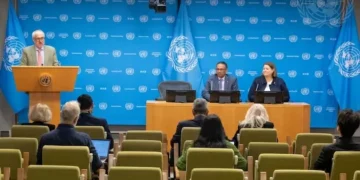
Former UN Climate Chief Christiana Figueres has praised the crucial role of small island states in maintaining the integrity of international climate agreements. However, she also expressed her concern that the world is far behind in taking necessary actions to combat climate change. Despite this, Figueres remains optimistic and believes that the decarbonisation of the global economy is now irreversible, with or without the “craziness” in the United States.
In a recent interview, Figueres highlighted the significant contribution of small island states in the fight against climate change. These nations, often overlooked in global discussions, have been at the forefront of advocating for ambitious climate action. They have been vocal in their calls for urgent and concrete measures to reduce greenhouse gas emissions and mitigate the impacts of climate change.
Figueres praised the efforts of these small island states, stating that they have been “punching above their weight” in terms of their contributions to international climate agreements. Despite their limited resources and vulnerabilities to the effects of climate change, these nations have shown great determination and leadership in pushing for a more sustainable future for all.
However, Figueres also expressed her disappointment in the slow progress of the global community in addressing the climate crisis. She emphasized that the world is far behind in meeting the goals set by the Paris Agreement, which aims to limit global temperature rise to well below 2 degrees Celsius. The recent report by the Intergovernmental Panel on Climate Change (IPCC) further highlights the urgent need for immediate and drastic action to avoid catastrophic consequences of climate change.
Despite these challenges, Figueres remains hopeful and believes that the decarbonisation of the global economy is now inevitable. She stated that the transition to a low-carbon economy is already underway and is irreversible. This is evident in the increasing number of countries and businesses committing to net-zero emissions by 2050. The growing demand for renewable energy and the declining costs of clean technologies also indicate a shift towards a more sustainable future.
Figueres also addressed the current political situation in the United States, where the country has withdrawn from the Paris Agreement under the Trump administration. She referred to the current political climate as “craziness” but emphasized that it will not hinder the global efforts towards decarbonisation. She stated that the US may be a significant player in the fight against climate change, but it is not the only one. The rest of the world, including small island states, will continue to take action and lead the way towards a greener and more sustainable future.
In conclusion, Figueres’ praise for small island states and their role in maintaining the integrity of international climate agreements is a testament to their determination and resilience in the face of the climate crisis. However, she also reminds us that the world is far behind in meeting the goals set by the Paris Agreement. Despite this, she remains optimistic and believes that the decarbonisation of the global economy is now irreversible. It is up to all of us, individuals, governments, and businesses, to take immediate and concrete actions towards a more sustainable future for our planet. Let us follow the lead of small island states and work together to combat climate change and secure a better future for generations to come.