
Rare Solar Eclipse Captivates Millions Across UK and Europe
Rare Solar Eclipse Captivates Millions Across UK and Europe
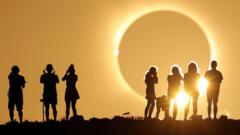
A rare solar eclipse captivated millions of people throughout the United Kingdom and Europe, offering an unforgettable celestial spectacle that occurred only once in a generation. The extraordinary astronomical phenomenon drew enthusiasts, families, and scientists to vantage points across the continent, eager to witness the Moon progressively obscure the Sun's brilliant face across the sky.
Unprecedented Sun Coverage in Cornwall
The southwestern county of Cornwall experienced exceptional conditions during this rare solar eclipse, with more than 95% of the Sun obscured by the Moon at the peak of the event. Observers stationed across Cornwall's beaches, parks, and open spaces utilized specialized eclipse glasses to safely view the phenomenon as the lunar shadow swept across the landscape. The near-total coverage transformed daylight into an ethereal twilight, creating an atmosphere of wonder among the thousands gathered to witness this remarkable celestial alignment.
The high percentage of sun coverage in Cornwall made it one of the most favorable observation locations in the entire United Kingdom. Astronomy clubs, educational institutions, and casual observers coordinated viewing events throughout the region, ensuring maximum accessibility for those seeking to experience the rare solar eclipse firsthand. The extended duration of darkness during midday hours demonstrated the impressive scale of the Moon's silhouette against our star.
Total Eclipse Visibility in Spain
While the United Kingdom witnessed a near-total obscuration, portions of Spain experienced the complete totality of this rare solar eclipse. The path of totality crossed through Spanish territory, allowing fortunate observers in those areas to witness the Moon completely block the Sun's photosphere, revealing the ethereal corona that surrounds our star. This spectacular display provided scientists and amateur astronomers with invaluable opportunities to collect data and capture images of one of nature's most dramatic celestial events.
The regions of Spain that fell within the path of totality reported extraordinary atmospheric changes during the eclipse's maximum phase. Temperatures dropped noticeably, wildlife exhibited unusual behavior, and the quality of light transformed into something entirely otherworldly. For many observers in these fortunate locations, the rare solar eclipse represented a once-in-a-lifetime opportunity to witness totality.
Continental Impact and Observations
Beyond the United Kingdom and Spain, the rare solar eclipse influenced weather patterns and observations across multiple European nations. Countries positioned along the eclipse's path experienced varying degrees of sun coverage, from partial obscuration to near-total conditions. The continental scope of this astronomical event emphasized the grandeur of celestial mechanics and the precise positioning required for such occurrences to manifest.
Meteorological stations throughout Europe documented atmospheric changes during the solar eclipse, while observatories deployed specialized equipment to study the Sun's corona and outer atmosphere. The rare solar eclipse provided unprecedented scientific opportunities for researchers studying solar physics, atmospheric dynamics, and the interaction between celestial bodies.
Public Engagement and Celebration
The rare solar eclipse generated unprecedented public enthusiasm across Europe, with millions taking time to participate in this celestial celebration. Schools organized viewing events, allowing students to observe and learn about astronomical principles firsthand. Community gatherings brought strangers together in shared wonder at the universe's spectacular displays. The collective human experience of witnessing the Moon traverse before the Sun created lasting memories for participants across all age groups.
Safety remained paramount throughout the rare solar eclipse event, with health authorities and astronomy organizations emphasizing proper eclipse glasses and indirect viewing methods. The widespread distribution of eclipse information ensured that millions could participate safely in this extraordinary phenomenon. Media coverage amplified the significance of the event, connecting those unable to travel to optimal viewing locations with real-time observations and expert commentary.
Historical Significance
This rare solar eclipse holds substantial historical significance as a generational event unlikely to repeat across these same European regions for decades to come. The alignment of celestial bodies and Earth's position created conditions that made this particular eclipse extraordinary in its accessibility and scale. For those who witnessed this rare solar eclipse, the memory of daylight transforming into premature dusk under the Moon's shadow will endure as a profound reminder of our place within the cosmos.


